Join this summer for an unforgettable #watercolor #workshop in Italy.
Details here:
https://italianatours.com/zan-barrage-tour-painting-2019/

Sunday, December 23, 2018
Friday, December 21, 2018
Sunday, November 25, 2018
Last Run! A full 1hr video watercolor lesson
Last Run! Coming soon to my Patreon Channel
Full 1 hr video Watercolor demo lesson
PDF file with detailed learning and instructions
Why not join us now?


Tuesday, September 11, 2018
Cuba winter escape workshop deadline
Heads up!
I was just informed that the low pricing that we negotiated for the Cuba winter escape workshop are running out at the end of the month. That means that we have to secure 12 participants before then or drop the trip this year. The trip is slated for January 19-26, but these bookings are set only for a limited time and we are running out of that. Pricing is $1,970 Double occupancy. This includes EVERYTHING. Plane travel, resorts, meals, drinks, workshop and 2 day trips to Havana. The base cost jumps $400 after October 1st.

It would be a shame to miss this wonderful opportunity to spend time painting on the beach and in the old city of Havana. Especially with the forecast in Canada calling for a colder than usual winter. Our resort is one of the best and with the two day trips to Havana to discoverer the city and paint on location is an absolute must.
So if you have been thinking about this trip or on the fence thinking "I have time to think about this" here is a note to let you know we need your answer this month, this week is even better!
All the details on the trip are here. Call Tanja today (Tel (416) 640.0433 ext 23 or 866.468.4741) if you are interested or if you have any questions, but please do not delay any longer.

Tuesday, August 28, 2018
School is back, Join us on Patreon September 1
September is the perfect time to work on your #watercolor skills. Join us with our weekly online video watercolor classes. No matter if you are a beginner or an advanced artist, there is something for you in the weekly video classes. Join us September 1. https://www.patreon.com/posts/introduction-and-15979885 https://www.https://www.patreon.com/posts/introduction-and-15979885


Sunday, August 05, 2018
Tuesday, July 31, 2018
Take5HardSoftEdges
I am going to start adding 5 minute lessons focusing on watercolor, drawing and painting principles. These will be targeted to our members who are starting out, but will also be helpful and refreshers and reminders to everyone.
Here is the first one. Hard and Soft edges.
Lines that delineate edges can either be soft or hard edges. Soft edges allow for the object or mass to loosely merge with the other mass next to it while a hard line or edge clearly shows a separation of objects or masses.
Saturday, July 14, 2018
Friday, July 13, 2018
Saturday, June 16, 2018
DIY Watercolor French Easel
Change a french easel to a watercolor easel similar to Joseph Zbukvic's field easel. This is a very easy DIY you can do it with minimal tools and mostly the hardware that comes with the french easel.
Let me know what you think.
Saturday, May 26, 2018
Change your French Easel to a perfect Watercolor Easel DIY
I have always eyed Jospeh Zbukvic's easel with envy. I love how it opens up and allows him to use the drawer as a shelf to place his brushes and palette on it.

I have this old french easel which I don't like because it places the open drawer between me and the painting. For me to get close to the paper, I have to strain my back and lean over the drawer. Whether I sit or stand, that posture is hard on my back and does not allow me the freedom of motion or to be expressive with my brush strokes. Not a good idea.

The same is true for pochade boxes. The box opens with the paper far away from me and the tray right in the middle of things. Again not a good design for watercolors. Having the palette sit between me and the paper, and having the paper sit just about an inch from the colours just does not work for watercolors. Our brushes are short and we do like to touch the paper. Our paints get wet, and in close proximity to the paper accidents are bound to happen.
Pochade and French easels where designed for oil painters. When I paint in oil, I open my pochade at 160 degrees so that the paints are sitting on almost the same slant as my board or canvas. That allows me a closer approach to the painting surface, but with watercolours, I need to have my paints on a level.
So after studying Joseph's easel for a while, I finally figured out a way to fix my French easel. I removed the top completely leaving behind the legs, base and drawers. I then made a new top that opened sideways and allowed the drawer to be pulled to my right (I am right handed but you can switch that if you are left handed). I made the top flat with a thin shelf to hold my block, or board with taped paper and even built a hook for a water can and a place for my umbrella to sit in. I took it out for a test run last week and it works like a charm.
Here is my fix for the French Easel. I hope you enjoy it!
Tuesday, March 06, 2018
Saturday, December 30, 2017
BIG ANNOUNCEMENT
Finally I am just about ready to announce something big. Something really really big and that will hopefully involve you and me painting together!!!
Monday, December 01, 2014
Watercolors? Make it a large Palette.
For oil painters, the idea of limited palettes is well ingrained. All you need is a warm and cool of each of the primaries and a white and you are basically good to go. This is something artists who start out in oils tend to want to migrate with them to watercolors. You wouldn't think of it for pastels of course, but somehow watercolors are seen as closer to oils in a manner.

That is not exactly true. As a matter of fact there is more in common between pastels and oil paints than with oil paints and watercolors. Mostly pastels and oil paints are used in opaque applications, while watercolors are transparent.

That is the key. It is well known that the more you mix colors, the less vibrant and more muddy they become. In the case of transparent watercolors, I prefer no mixing on the palette at all. If any mixing needs to happen, it is better for that to happen on the paper so that their vibrancy remains intact. That is why I have an embarrassingly large color collection on my palette. I admit that I rarely use more than a few at a time, but I like to have them there ready for use any time I needed them.

The less one mixes watercolors the more these colors reward you in the end. I understand that many of the colors on my palette are not single pigment colors. Some are mixes in their own right, but a color-man's mixture in the milling or composing process is very different from an artist's mixture. One is calibrated and ends up in a consistent product, the other is done in the heat of the painting process.
That is not exactly true. As a matter of fact there is more in common between pastels and oil paints than with oil paints and watercolors. Mostly pastels and oil paints are used in opaque applications, while watercolors are transparent.
That is the key. It is well known that the more you mix colors, the less vibrant and more muddy they become. In the case of transparent watercolors, I prefer no mixing on the palette at all. If any mixing needs to happen, it is better for that to happen on the paper so that their vibrancy remains intact. That is why I have an embarrassingly large color collection on my palette. I admit that I rarely use more than a few at a time, but I like to have them there ready for use any time I needed them.
Saturday, April 26, 2014
Pochade 5th Anniversary - (Still as solid as a tank!)
After many tests and planning I built my pochade box five years ago and made the plans available online for everyone who wants to build one. Many people have bought the detailed step by step plans. They are just $2.99. I would love to hear from them through this post and hopefully receive photos that I can share as well. It would really be wonderful.


I never regretted building my own pochade as opposed to buying one. The cost was one big factor at the beginning. It cost me less than $100 to build mine. Actually much less. But that was not all. I initially built my pochade to withstand a lot of abuse. I noticed that the ones commercially available were too dainty and I needed something that can handle being outdoors regularly not just on occasion. Over the years my pochade has survived countless accidents including falling off the top of the SUV while I drove away, being dropped down a steep hill and tumbling into a stream. You name it it has survived it. I won't even mention all the small falls, the bangs and tripod drops that I know the more dainty ones would not survive.
The best part is that I feel it is getting stronger every year! The caking of paints and dried oil in cervices has served to make it even more solid. It also gave it an air of experience. It has been in many battles and just keeps getting better by the day.
What is your pochade like? If you built one based on my plans, please share and send me photos to add to this post if you can.
Wednesday, April 23, 2014
Narrative In Design - A pastel by Clarence Gagnon

Lucille Rodier Gagnon, Olive and Edna Pretty at Sainte-Pétronille, Île d’Orléans / Clarence Gagnon - 1919
This deceptively simple pastel by Clarence Gagnon is a study in design and composition. The design is not simple or formulaic or done for aesthetics alone as we will see. It impacts directly on the subject of the painting in a way that builds a narrative that can only be told through this design.
At first glance the pastel is a simple image of three ladies sitting on a fence at the edge of a river. The scenery is de-emphasized in favor of the three figures that are painted in higher chroma (brighter), and harmonious colors that make them stand out from the rest of the painting. But is there more about these girls than meets the eye? What is the story?

The blue clothing brings the right and middle figures together in the shape of the letter M forming a bond between them. The white clothing does the same in the shape of a W between the left and right figures. Their harmony of color intermingle to tell us of a friendship or a relation of the three. But something is amiss. While the two figures on the left each has her own lines that signal affinity with the figure on the right, somehow this linear affinity is not shared between them. They are close in proximity, but they each have an underlying secret affinity with the figure on the right.

There is an air of deceptive calmness to the painting that is brought about by the horizontal likes that outline the river banks. these split the painting into three almost equal horizontal areas also adding to the seeming calm. It is when you divide the painting vertically that you start seeing the tension that Gagnon has placed in there. You can clearly see that the left and middle figure have their heads almost touching. This is counter balanced by the further head of the right figure. The direction of the torsos in the figure also echo this affinity of the left and middle figure and the alienation of the right one.

More importantly though if you also draw vertical lines to divide the painting you would see how the tension is so expertly placed. The two figure on the left occupy the calm center of the painting. While the right figure literally teeters on the edge.
The scene is peaceful, but something is not quite right with the ladies in the painting. How complex are their relationship with each other? Are there secrets that are not shared between the three? Gagnon hints to that, but leaves us to build the rest of the narrative. What an amazing painting isn't it?
Wednesday, April 18, 2012
Utility Tray Addition to the Portage Pochade Box
I just finished building an addition to the Portage pochade. This utility tray attaches to the pochade and helps me keep all my gear together and not lose things along the way.

Here is the video on how to build it. If you need help let me know.

Here is the video on how to build it. If you need help let me know.
Saturday, June 05, 2010
Additions to the home made Sojourn Pochade
Today I finally published the latest Sojourn Pochade plans. The plans now include:
1) The plan for the Sojourn Pochade (15 1/2" x 12 1/2" x 2 1/2") carrier 11"x 14" panel
2) The plan for the Portage Wet panel Carrier (15" x 12" x 3") carries 6, 11"x14" panels
3) The plan for two Panel Dividers for the Sojourn pochade. These allow the Sojourn pochade to carry either two 6"x8" panels or one 8"x10" and one 5"x7" Panels instead of the 11"x14" panel that it was sized for.
 The updated plans have been sent to those who purchased the original plans so they can add the dividers to their project.
I could make other plans for a smaller pochade and wet panel carrier based on the Sojourn, but I will wait to hear from you on your needs first.
It was a lot of fun building and planning this pochade, and I hope many people try it and spread the word about it. I would seriously suggest that it is a better pochade than many commercial ones that are out there.
1) The plan for the Sojourn Pochade (15 1/2" x 12 1/2" x 2 1/2") carrier 11"x 14" panel
2) The plan for the Portage Wet panel Carrier (15" x 12" x 3") carries 6, 11"x14" panels
3) The plan for two Panel Dividers for the Sojourn pochade. These allow the Sojourn pochade to carry either two 6"x8" panels or one 8"x10" and one 5"x7" Panels instead of the 11"x14" panel that it was sized for.
 The updated plans have been sent to those who purchased the original plans so they can add the dividers to their project.
I could make other plans for a smaller pochade and wet panel carrier based on the Sojourn, but I will wait to hear from you on your needs first.
It was a lot of fun building and planning this pochade, and I hope many people try it and spread the word about it. I would seriously suggest that it is a better pochade than many commercial ones that are out there.
Monday, May 24, 2010
The Ultimate Do-it-yourself Pochade Box
Ok! I finally did it. After weeks of planning and researching, I think I have built the ultimate pochade box. Here is the launch:
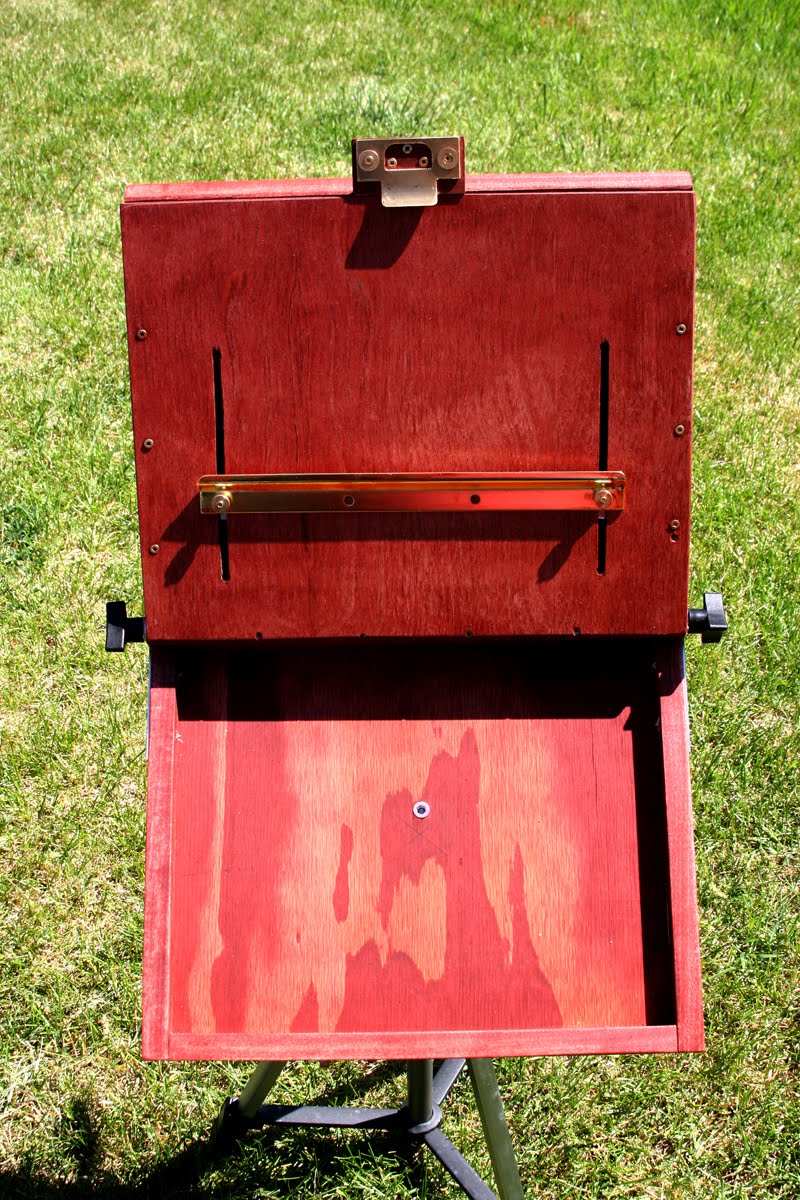 The Sojourn is a plein air pochade box designed for artists who demand versatility from their tools and expect value at a low price. A one day garage-bench project, the Sojourn - which comes with its own wet panel carrier the Portage - can be built using the minimum of hand tools that are found in most suburban garages. It cost less than $90 in material to build this 12 1/2” x 15 1/2” x 2 1/2" slick pochade box and wet panel carrier, and what’s more you don’t have to be a workshop master to build the Sojourn. Everything you need is readily available at your local hardware store. Just take the shopping list that is provided and check-off the items as you place them in the cart. The detailed easy to follow step by step instructions below along with the diagrams will guide you through the project and help you finish your dream pochade in one rainy day.
 The Sojourn Pochade has no equal in the market. Designed by a plein air artist for plein air artists, it is a light weight box (less than 6Lbs) that comes with its own slick wet panel carrier – the Portage. The Sojourn can carry one 11” x 14”. For longer trips the Portage wet panel carrier can carry up to 6 panels. Drop the Sojourn Pochade and the Portage wet panel carrier in a backpack and you are ready to go. I will be adding plans for partitions so you can turn the carring space to 6x8, 8x10 etc... soon so if you buy the plans, you will also get the partition plans as soon as I have them ready.
I have worked hard to document this pochade and help others build it from everyday material that you can find at the hardware store. As a matter of fact, the shopping list which comes with the plan is all you need to buy to get the project done.

To get the plan click here if you have an iPad or a Mac, you can also get the plans on iBooks or iTunes. Cost? $2.99! The price of a cup of Java! Get it!!

Subscribe to:
Posts (Atom)